What should a practice automate first?
The work that is repeated, rule-bound and late. In a South African practice that is invoicing, statements and the chasing of both. Xero’s 2025 South Africa Late Payments Report found 91% of small businesses affected by late payment, with invoices paid an average of 18 days after the due date, and its 2024 State of Small Business report found 46% of small businesses spending one to two months a year chasing money 1. Every hour of that chasing is an hour a practice can bill for something else.
Automation here means the document is produced the moment the work is done, the statement goes out on the first of the month with 30/60/90-day ageing already computed, and the reminder sends itself when the due date passes. Nobody has to remember, so nobody forgets.
What is safe, and what is not?
| Task | Automate? | Why |
|---|---|---|
| Quotes and tax invoices from a rate card | Yes | Rule-bound; the numbers come from your own rates |
| Statements with 30/60/90 ageing | Yes | Arithmetic on the ledger |
| Payment reminders and pay-now links | Yes | Timed, templated, logged |
| Client intake and document requests | Yes | A checklist a chatbot can run |
| Bank-statement categorisation | Assisted | AI proposes, a person confirms |
| Tax opinions, sign-off, advice | No | A professional’s judgement and liability |
The line is liability. If a client could sue over the number, a person signs it. If the number is arithmetic on data the client gave you, software can produce it, and produce it correctly every time.
What does a SARS-ready invoice need?
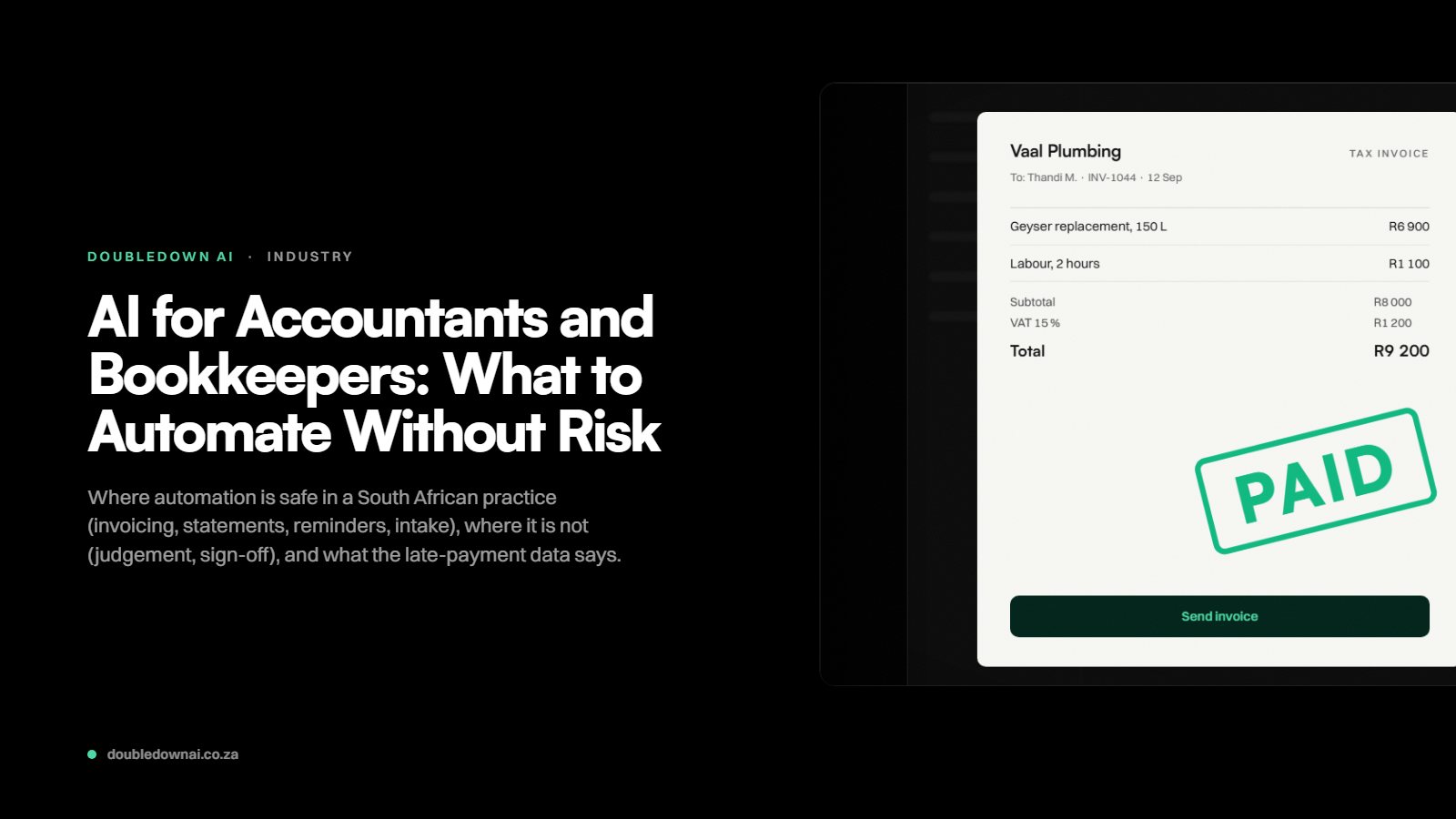
The fields the Value-Added Tax Act asks for, and numbering that does not skip. A tax invoice carries the supplier’s name, address and VAT number, the words “tax invoice”, a unique sequential number, the date, the customer’s details, a description, the amount and the VAT. Gapless numbering matters because a gap looks like a deleted invoice to an auditor. This is precisely the kind of rule a system enforces better than a person: our bookkeeping and invoicing product locks an issued invoice, numbers gaplessly and fixes mistakes with a credit note, which is what an auditor expects to see.
Is client data a POPIA risk?
A practice holds ID numbers, bank details and financials for every client, which is close to the most sensitive personal information there is. POPIA has been fully in force since 1 July 2021; the Information Regulator can impose an administrative fine of up to ten million rand and non-compliance with an enforcement notice is an offence 2. The first fine, five million rand against a government department, was issued in 2023 3. The rules for automation are the rules for everything else: collect the minimum, encrypt it, keep the log, and be able to delete it when asked. A system that stores documents in one place with an audit trail is easier to keep compliant than a shared drive.
Are practices actually adopting this?
McKinsey’s 2025 global survey found 88% of organisations using AI in at least one function, up from 78% a year earlier 4. In professional services the early adopters use it exactly where this article draws the line: intake, drafting, categorisation and chasing, with a professional reviewing anything that leaves the building under the practice’s name.
What is the honest limit?
AI does not make a bookkeeper redundant. It makes the bookkeeper’s month shorter by removing the parts that were never bookkeeping: retyping a quote into an invoice, working out who is 60 days late, writing the same reminder for the fifth time. The judgement stays where it is.
Questions people ask
Can an accepted quote become the invoice automatically?
Yes. In our bookkeeping product the client accepts the quote online and it becomes the invoice with the same line items and numbering, without anything being retyped.
Does the software file VAT returns?
No. It produces the documents and the ledger; the return is a professional’s work and stays with the practice.
What does the bookkeeping product cost?
From R190 a month with no setup fee; the first month is all the checkout takes, and it is month to month.
Sources
- Xero, “South Africa Late Payments Report” (2025), reported by IOL, January 2025
- Protection of Personal Information Act 4 of 2013, section 109 (administrative fines) — popia.co.za
- Bowmans, “Information Regulator issues first fine of ZAR 5 million under POPIA” (2023)
- McKinsey & Company, “The State of AI: Global Survey 2025” (1,993 respondents, 105 countries)
Where we do this
If you are reading this from Soweto, Midrand and Paarl, those pages go through the local version of it: which languages the bot needs, what the busy hours look like, and which sectors ask what.