What does an AI social media tool actually do?
Three jobs, joined together. The first is making the content: a caption, an image, a video, produced from something the business already has, a product, a listing, a photo, a price. The second is the schedule: deciding when each piece goes out and in what order. The third is the connection: an authorised link to the platform’s publishing API that puts the post on the page without a person pressing the button. Any product that does the first two without the third is a content tool with a reminder; only the third makes it automation.
Why does the audience matter?
Because it is most of the country. DataReportal’s Digital 2026 report counts 29.1 million social media user identities in South Africa in October 2025, 44.9% of the population, on top of 51.7 million internet users 1. For a small business the audience is not the problem. The problem is that a page needs feeding every day and the owner has a business to run.
What does DoubleDown AI sell here?
Less than the category suggests, on purpose. We discontinued general social media automation as a product; a tool that writes generic posts for any business produces generic posts, and generic posts do nothing. What we sell instead is content from a real source and, in one case, the posting itself.
| Product | Makes the content from | Publishes it? |
|---|---|---|
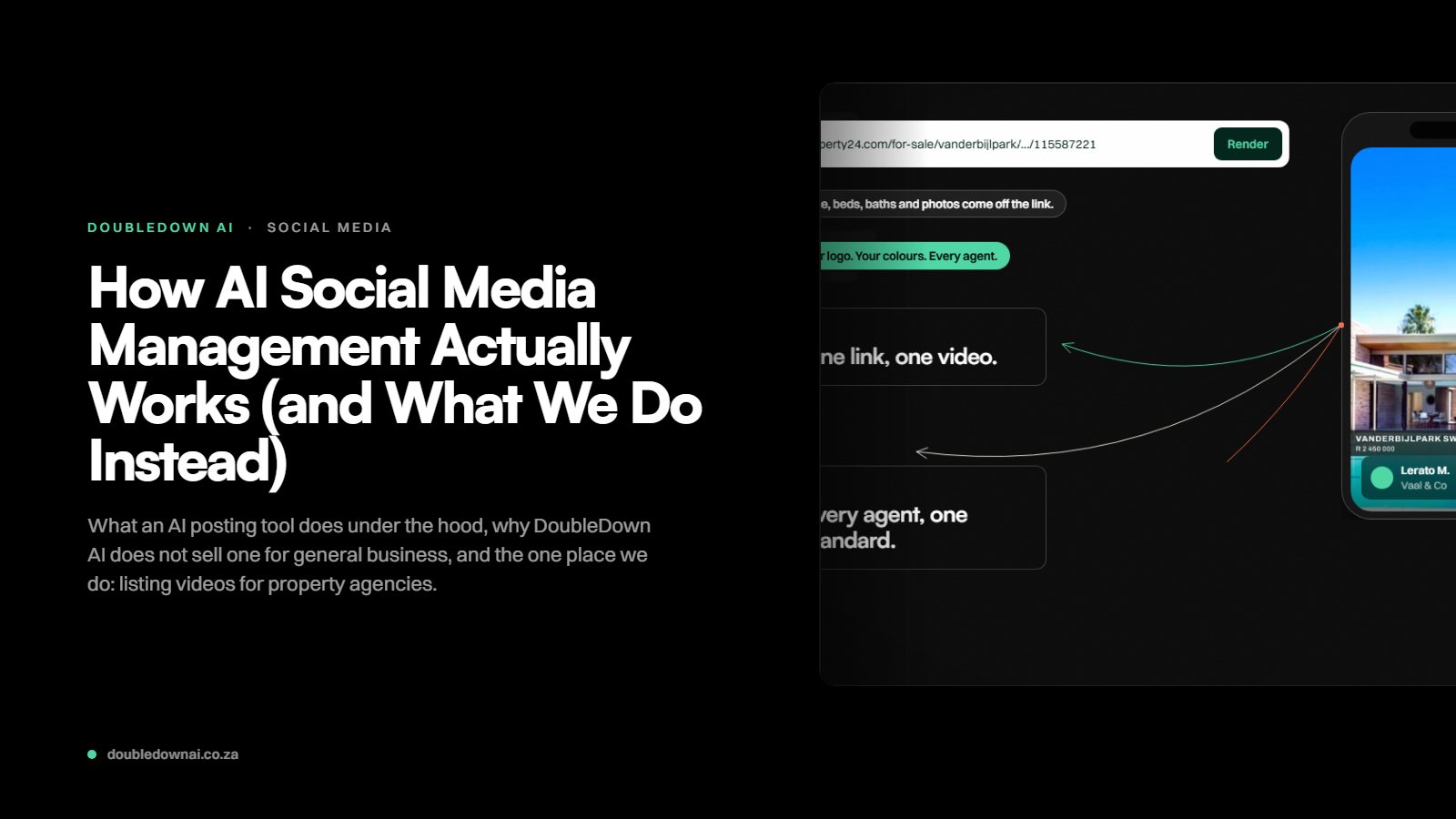
| Property Agent Automation | The agent’s Property24 listing link, brand and voice | No. The video comes back to the agent. |
| Property Firm Automation (Agents and Firm setups) | Every agent’s listings, one brand standard | No. The firm runs its own marketing. |
| Property Firm Automation, Autoposter setup | The agency’s Property24 book | Yes: eight videos and four images a day to the agency’s own Facebook and Instagram, on its own connected accounts. |
The Autoposter is the only product on this site that posts anything, and it posts to exactly two platforms: Facebook and Instagram. It works because the content comes from the listing itself, so every post is a real house at a real price, in the agency’s own brand.
How does the connection work?
Through Meta’s own API, with the agency logging in and authorising its pages. Publishing to an Instagram business account and a Facebook page requires specific permissions granted through Meta’s app review, with business verification behind it, and Instagram’s content publishing API caps an account at 25 published posts in 24 hours 2. A tool that promises posting without that review is either using a person’s login in a way that breaks the platform’s terms, or it will stop working the first time Meta looks. Ours went through the review, and twelve pieces a day sits well inside the cap.
What about scheduling and captions?
The schedule is set by the product: twelve pieces a day for the Autoposter, spread across the day, well inside Instagram’s own publishing limits. The captions come from the listing: the suburb, the bedrooms, the price, the agent’s name. Nothing is invented and nothing is generic, because a caption that could be about any house is a caption nobody reads.
Should a non-property business use an AI posting tool?
Only if the content comes from somewhere real. A restaurant’s specials, a retailer’s new stock, a tradesman’s finished job with a photo: those feed a page honestly. A tool that writes “Happy Monday! Here are five tips…” from nothing feeds it noise. If you want the first kind built for your business, that is a custom build, scoped from what you already produce every day.
Questions people ask
Does DoubleDown AI post to LinkedIn or TikTok?
No. The Autoposter publishes to Facebook and Instagram only, and it is available only on the Property Firm product.
Can I use the Autoposter for a non-property business?
No. It is built on property listings; the content comes from the listing link. Other businesses are quoted as a custom build.
Is there a free trial on the Autoposter?
Yes: fourteen days free for a new agency, one per agency, with both accounts connected for the full fortnight. The details and the conditions are on the Property Firm page.