Which tool is best?
The wrong question, because the general models leapfrog each other every few months and a ranking written in January is stale by April. The useful question is what a writing tool is for, and the answer has been stable for two years: drafts, rewrites, summaries, translations and tone. Any of the major assistants does those well. What none of them does is know a fact it was not given, and that is where every AI writing disaster in business has come from.
What should a business use one for?
| Task | Good use | Rule |
|---|---|---|
| First draft of an email, a page, a proposal | Yes | A person edits before it leaves |
| Rewriting for tone or length | Yes | Check nothing was added |
| Summarising a long document | Yes | Spot-check against the original |
| Translating into Afrikaans, isiZulu, Sesotho | Yes, as a draft | A speaker reads it |
| Statistics, studies, citations | No | Find the source yourself; link it |
| Legal, tax or medical wording | No | A professional signs it |
What is the honesty rule?
Every number gets a link, and every link gets opened. A writing tool asked to make a page persuasive will invent a survey, a percentage and a consultancy to attribute it to, and it will do so fluently. Published, that is a false claim under your name that anyone can check in a minute. Google’s guidance on AI content asks for exactly this discipline: focus on accuracy, quality and relevance, and consider telling readers how AI was used; content made primarily to manipulate rankings is spam, however it was produced 2.
How is adoption going?
Fast, and shallow. McKinsey’s 2025 survey of 1,993 organisations found 88% using AI in at least one function, up from 78% the year before, with most still in pilots and a minority reporting an effect on profit 1. Writing assistance is the common first step because it needs no integration. It is also the step where a bad habit, trusting the output, forms first.
What about writing that goes out automatically?
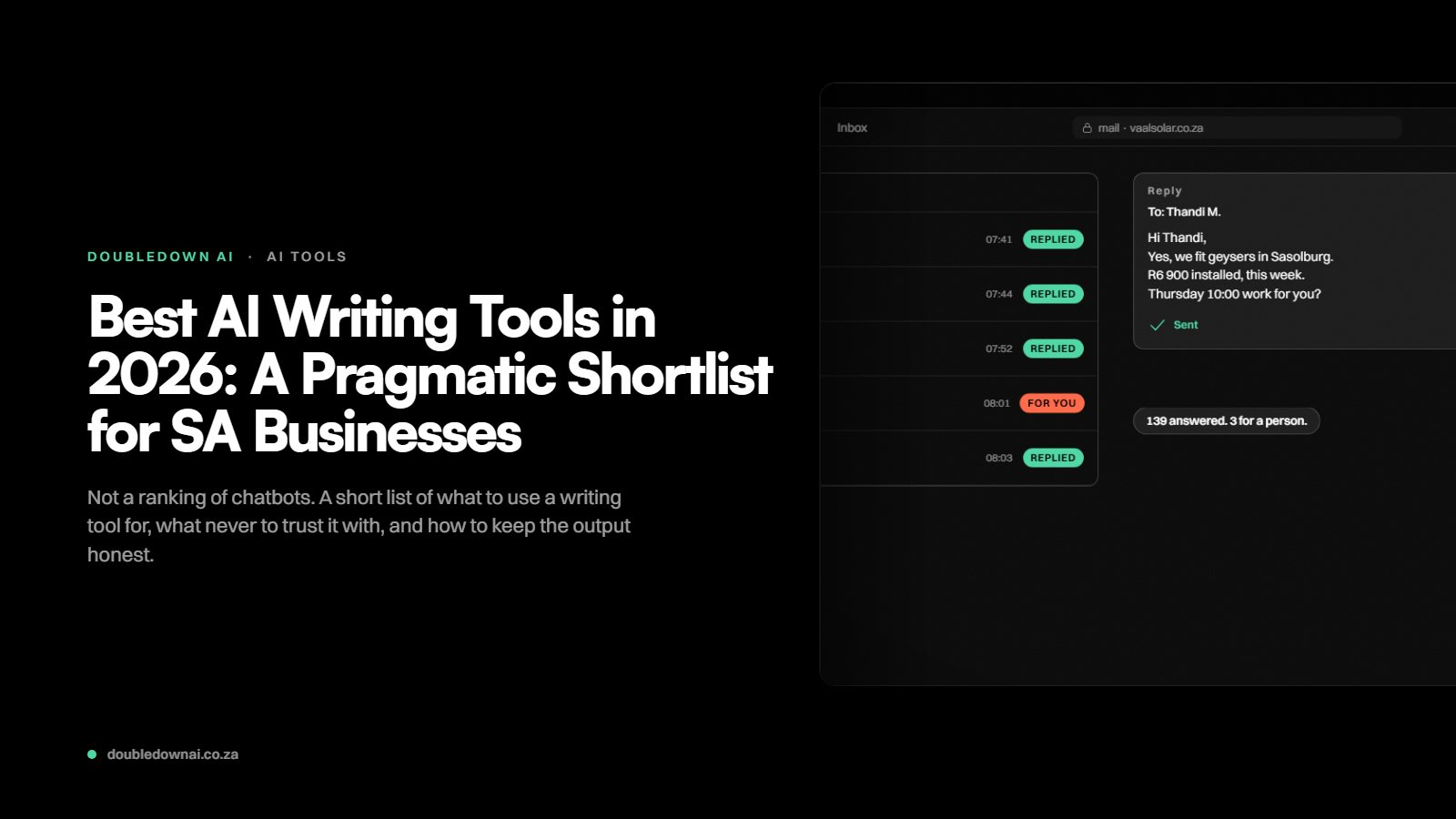
That is a different product, with a different safety model. An email agent that replies to customers on its own is trained on your own previous replies and your own documents, so it answers from your truth rather than a model’s guess; it runs in draft mode until you trust it; and it escalates anything it was not trained on. A general writing tool with a “send” button is not that.
Which tool for which language?
For English, any of them. For Afrikaans, the major assistants are usable for a first draft and a native reader will still change a phrase in every paragraph. For isiZulu, Sesotho and the other official languages, treat the output as a rough draft for a speaker to rewrite, not a translation to publish. The tool that is best for South African business writing is the one attached to a colleague who speaks the language.
What should a South African business pick?
Any of the major assistants for drafting, with one rule enforced: nothing leaves the building unread. For customer-facing writing at volume, a tool trained on your own content with an approval step. And for the site itself, copy written by a person who knows the business, structured to be found; that is what the website design product includes.
Questions people ask
Which AI model does DoubleDown AI use?
Our products use more than one model, chosen per task, behind our own guardrails. The model is not the product; the training on your content and the approval step are.
Can a writing tool write in isiZulu?
It can draft in it. Have a speaker read it before it goes out; idiom and register are where drafts go wrong.
Will Google know a page was AI-drafted?
It does not try to. It judges whether the page is useful and whether it was made to manipulate rankings 2.