Where do buyers start?
Online, almost all of them. The National Association of Realtors’ 2024 profile found 43% of buyers took their first step by looking at properties on the internet, and that nearly every buyer used the internet somewhere in the search; 86% still bought through an agent 1. The pattern is the same on Property24 and Private Property: the search is digital, the enquiry is digital, and the agent is still the person who closes.
Why do agents lose enquiries?
Because they arrive while the agent is at a viewing, driving, or asleep. Harvard Business Review’s audit of 2,241 companies found that a web lead contacted within an hour was nearly seven times as likely to be qualified as one contacted even an hour later, and sixty times as likely as one left for a day; 23% of companies never responded at all 2. An agent with forty enquiries a week and one phone is structurally in the slow group.
What does a chatbot do for an agent?
It answers the first message within seconds and asks the questions the agent would ask: buying or renting, which areas, what budget, when. It takes the viewing request and passes it to the agent with every detail filled in. The agent gets a qualified lead with the answers already filled in, instead of a name and a number to call back.
| Enquiry | Without | With a chatbot |
|---|---|---|
| “Is the Vanderbijlpark house still available?” | A missed call at a viewing | Answered; viewing booked |
| “What is the levy?” | A callback that evening | Answered from the listing |
| “I’m renting, budget 9k, Three Rivers” | Noted on paper | Qualified and saved to the CRM |
| Sunday 21:00 | Nothing until Monday | Answered; viewing booked for Tuesday |
What about the marketing?
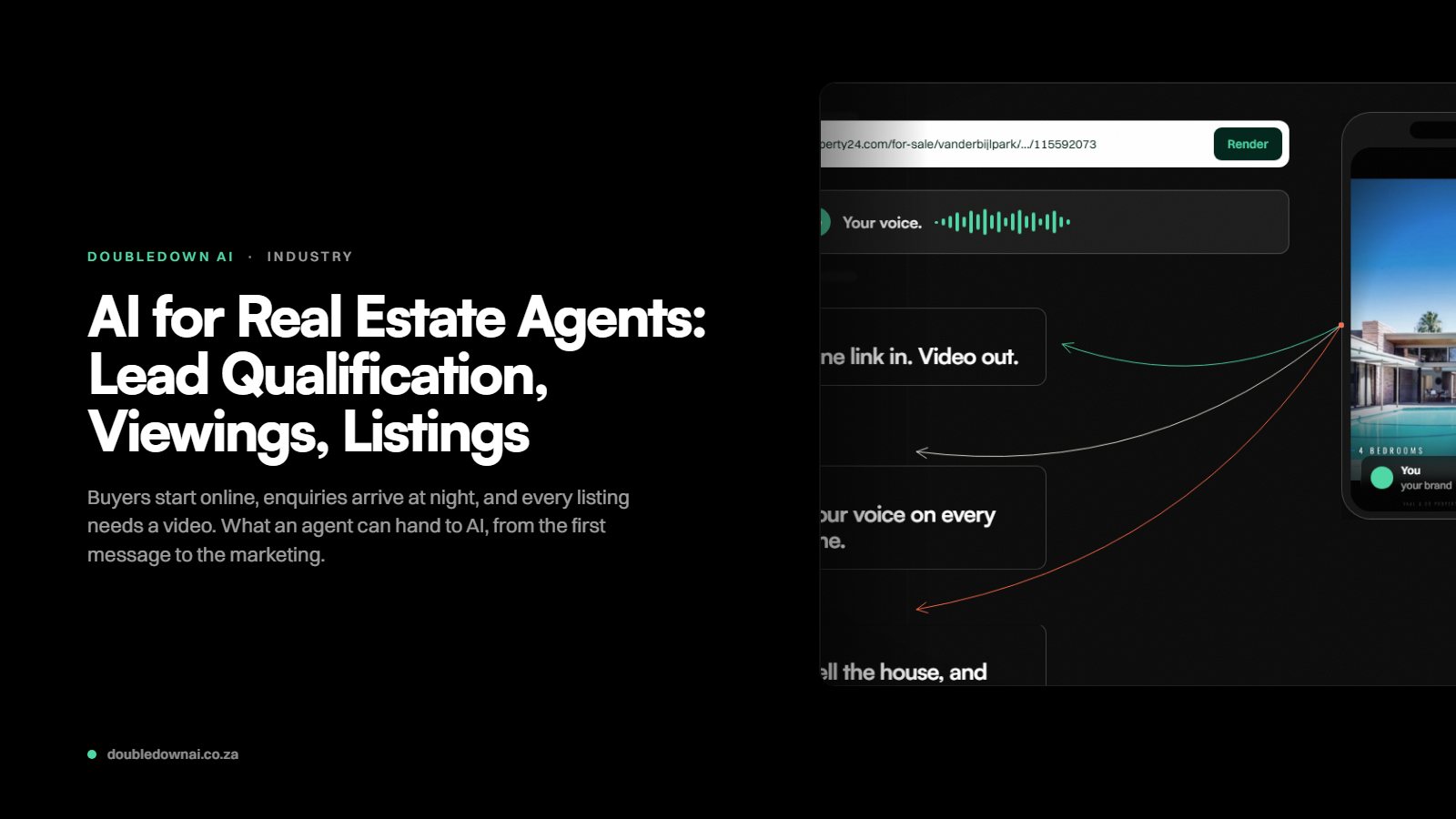
Every listing needs a video and most agents cannot make one. The property products render it from the listing itself: the price, the bedrooms, the bathrooms and the photographs come off the listing link, the agent’s logo and colours are baked in, and the narration is the agent’s own voice from a one-minute recording. The property agent product does this for an individual agent; the firm product does it for every agent in an agency, in one standard.
The video comes back to the agent as a file. What the agent does with it is the agent’s marketing.
What stays with the agent?
The viewing, the negotiation and the relationship. A chatbot does not know that the seller will take an offer below asking, or that the buyer’s bond is shaky, or that the house two streets over is about to list. It knows the listing and the diary. The agent who lets it handle the first message and the marketing has more hours for the part of the job that earns the commission.
Is this actually being adopted?
McKinsey’s 2025 global survey found 88% of organisations using AI in at least one function, and marketing and sales among the leading functions 3. In property the use that has stuck is the unglamorous one: the first reply, the qualification questions and the listing marketing, with the negotiation and the relationship kept with the agent.
What does it cost?
The website chatbot starts at R299 a month plus R250 setup, month to month. The property products are quoted for the agent or the agency; request a quote from the product page and the pricing comes back with the information pack.
Questions people ask
Can the chatbot answer questions about a specific listing?
Yes, if the listing is on your website. It answers from the listing page: price, size, levies, availability.
Does the property product need my logo?
Yes. It renders in your brand or it does not render at all; there is no house default, so nothing goes out looking like somebody else’s.
How is the narration made?
You record about a minute of clean speech once. That voice narrates every video afterwards.
Sources
- National Association of Realtors, “2024 Profile of Home Buyers and Sellers” — highlights
- Oldroyd, McElheran & Elkington, “The Short Life of Online Sales Leads”, Harvard Business Review, March 2011 (audit of 2,241 US companies)
- McKinsey & Company, “The State of AI: Global Survey 2025” (1,993 respondents, 105 countries)
Where we do this
If you are reading this from Umhlanga and Centurion, those pages go through the local version of it: which languages the bot needs, what the busy hours look like, and which sectors ask what.